Coming Soon
| Title (pre-order linked) | Author | Description | Date |
| Practicing New Worlds: Abolition and Emergent Strategy | Andrea Ritchie | Practicing New Worlds explores how principles of emergence, adaptation, iteration, resilience, transformation, interdependence, decentralization and fractalization can shape organizing toward a world without the violence of surveillance, police, prisons, jails, or cages of any kind, in which we collectively have everything we need to survive and thrive. Drawing on decades of experience as an abolitionist organizer, policy advocate, and litigator in movements for racial, gender, economic, and environmental justice and the principles articulated by adrienne maree brown in Emergent Strategy: Shaping Change, Changing Worlds, Ritchie invites us to think beyond traditional legislative and policy change to create more possibilities for survival and resistance in the midst of the ongoing catastrophes of racial capitalism—and the cataclysms to come. Rooted in analysis of current abolitionist practices and interviews with on-the-ground organizers resisting state violence, building networks to support people in need of abortion care, and nurturing organizations and convergences that can grow transformative cities and movements, Practicing New Worlds takes readers on a journey of learning, unlearning, experimentation, and imagination to dream the worlds we long for into being. | 10/24/23 |
| Tip of the Spear: Black Radicalism, Prison Repression, and the Long Attica Revolt | Orisanmi Burton | Tip of the Spear boldly and compellingly argues that prisons are a domain of hidden warfare within US borders. With this book, Orisanmi Burton explores what he terms the Long Attica Revolt, a criminalized tradition of Black radicalism that propelled rebellions in New York prisons during the 1970s. The reaction to this revolt illuminates what Burton calls prison pacification: the coordinated tactics of violence, isolation, sexual terror, propaganda, reform, and white supremacist science and technology that state actors use to eliminate Black resistance within and beyond prison walls. Burton goes beyond the state records that other histories have relied on for the story of Attica and expands that archive, drawing on oral history and applying Black radical theory in ways that center the intellectual and political goals of the incarcerated people who led the struggle. Packed with little-known insights from the prison movement, the Black Panther Party, and the Black Liberation Army, Tip of the Spear promises to transform our understanding of prisons—not only as sites of race war and class war, of counterinsurgency and genocide, but also as sources of defiant Black life, revolutionary consciousness, and abolitionist possibility. | October 2023 |
| Witness: An Insider’s Narrative of the Carceral State | Lyle C. May | A first-hand account of the death penalty’s wholly destructive nature. In Witness, Lyle C. May offers a scathing critique of shifts in sentencing laws, prison policies that ensure recidivism, and classic “tough on crime” views that don’t make society safer or prevent crime. These insightful and analytical essays explore capital punishment, life imprisonment, prison education, prison journalism, as well as what activism from inside looks like on the road toward abolishing the carceral state. No outside journalist can adequately report what happens inside death row or what it is like to live through thirty-three executions of people you know. May’s grounded writings in Witness challenge the myths, misconceptions, and misinformation about the criminal legal system and death in prison, guiding readers on a journey through North Carolina’s congregate death row, where the author has spent over twenty years of his life. With a foreword by activist, lawyer, and professor Danielle Purifoy, and drawing on the work of Angela Y. Davis, Mariame Kaba, and other abolitionist scholars, Witness shows there is more to life under the sentence of death than what is portrayed in crime dramas or mass media. Lyle C. May’s life, journalism, and activism are a guidebook to abolitionism in practice. | 11/7/23 |
| Prison Capital: Mass Incarceration and Struggles for Abolition Democracy in Louisiana | Lydia Pelot-Hobbs | Every year between 1998 to 2020 except one, Louisiana had the highest per capita rate of incarceration in the nation and thus the world. This is the first detailed account of Louisiana’s unprecedented turn to mass incarceration from 1970 to 2020. Through extensive research, Lydia Pelot-Hobbs illuminates how policy makers enlarged Louisiana’s carceral infrastructures with new prisons and jail expansions alongside the bulking up of police and prosecutorial power. At the same time, these infrastructures were the products of multiscalar crises: the swings of global oil capitalism, liberal federal court and policy interventions, the rise of neoliberal governance and law-and-order austerity, and racist and patriarchal moral panics surrounding “crime.” However, these crises have also created fertile space for anticarceral social movements. From incarcerated people filing conditions of confinement lawsuits, to Angola activists challenging life without parole, to grassroots organizers struggling to shrink the New Orleans jail following Hurricane Katrina, to LGBTQ youth of color organizing against police sexual violence, grassroots movements stretch us toward new geographies of freedom in the lineage of abolition democracy. Understanding Louisiana’s carceral crisis extends our understanding of the interplay between the crises of mass criminalization and racial capitalism while highlighting the conditions of possibility for dismantling carceral power in all its forms. | 11/28/23 |
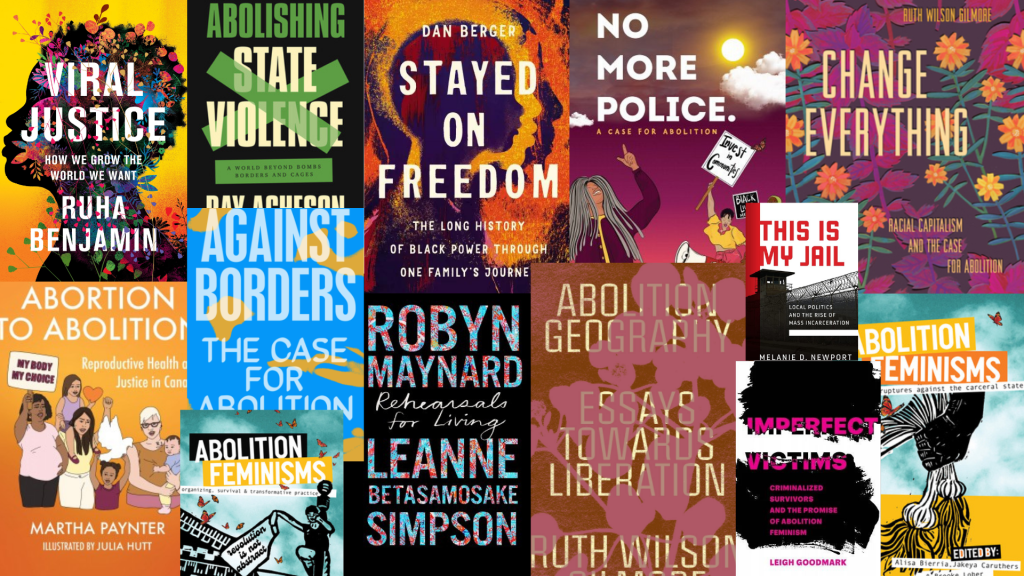
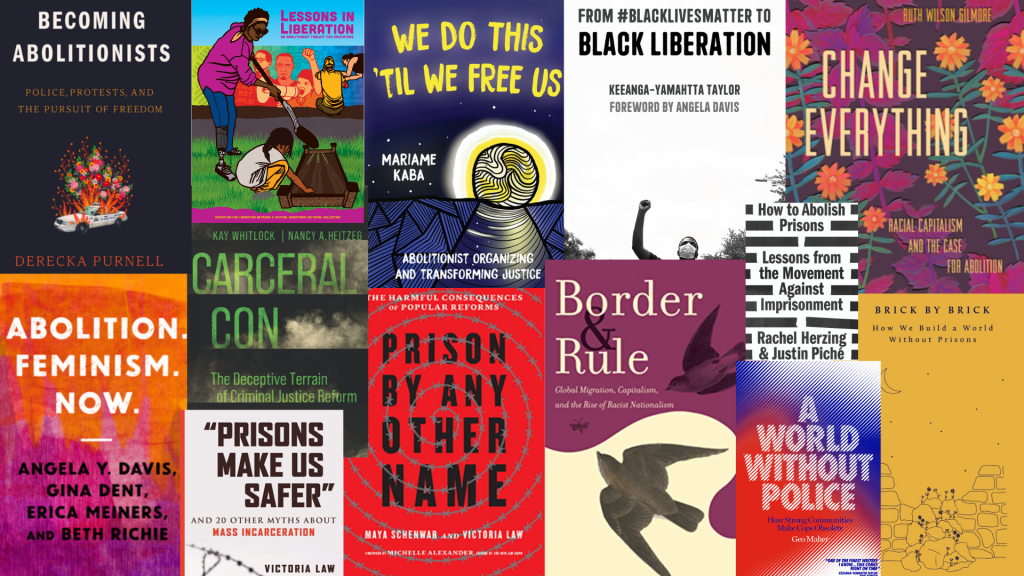
| Change Everything: Racial Capitalism & the Case for Abolition | Ruth Wilson Gilmore | Racial, gender, and environmental justice. Class war. Militarism. Interpersonal violence. Old age security. This is not the vocabulary many use to critique the prison-industrial complex. But in this series of powerful lectures, Ruth Wilson Gilmore shows that the only way to dismantle systems and logics of control and punishment is to change questions, categories, and campaigns from the ground up. Abolitionism doesn’t just say no to police, prisons, border control, and the current punishment system. It requires persistent organizing for what we need, organizing that ‘s already present in the efforts people cobble together to achieve access to schools, health care and housing, art and meaningful work, and freedom from violence and want. As Gilmore makes plain, Abolition requires that we change one thing: everything. | 12/5/23 |
| How to Abolish Prisons: Lessons from the Movement Against Imprisonment | Rachel Herzing and Justin Piche | In the 1960s and 1970s, groups like the U.S. Prison Research Education Action Project and the Norwegian Association for Penal Reform advocated for a world without prisons. Instead, incarceration boomed, growing in the United States from about 200,000 prisoners to an unprecedented 2 million and more. Now, a movement to abolish prisons has returned, with grassroots movements and critical research converging on an uncompromising critique of the regime of mass incarceration. This book provides a trenchant guide to prison abolition, explaining why the solution to the criminal justice crisis is ending policing, imprisonment, and mass surveillance, and building a society that creates alternatives to punishment and carceral solutions to social contradictions. The book details and evaluates abolitionist projects throughout North America that provide alternative models, and reveals what it means to work for abolition today, explores ways to ‘de-carceralize’ society. | 4/9/24 |
Recently Released
| The End of Family Court: How Abolishing the Court Brings Justice to Children and Families | Jane Spinak |
| Radical Acts of Justice: How Ordinary People are Dismantling Mass Incarceration | Jocelyn Simonson |
| Free Them All: A Feminist Call to Abolish the Prison System | Gwenola Ricordeau |
| Let This Radicalize You: Organizing and the Revolution of Reciprocal Care | Kelly Hayes and Mariame Kaba |
| Miss Major Speaks: Conversations with a Black Trans Revolutionary | Toshio Meronek and Miss Major Griffin-Gracy |
| We Were Once a Family: A Story of Love, Death, and Child Removal in America | Roxana Asgarian |
| Healing Justice Lineages: Dreaming at the Crossroads of Liberation, Collective Care, and Safety | Cara Page and Erica Woodland |
| Imperfect Victims: Criminalized Survivors and the Promise of Abolition Feminism | Leigh Goodmark |
| Stayed On Freedom: The Long History of Black Power through One Family’s Journey | Dan Berger |
| Policing the Pandemic: How Public Health Becomes Public Order | Lambros Fatsis and Melayna Lamb |
| Shoot to Kill: Police and Power in South Africa | Christopher Michael |
| This is My Jail: Local Politics and the Rise of Mass Incarceration | Melanie Newport |
| Detention Empire: Reagan’s War on Immigrants and the Seeds of Resistance | Kristina Shull |
| Abolition Revolution | Aviah Sarah Day and Shanice Octavia McBean |
| Abolitionist Intimacies | El Jones |
| Health Communism: A Surplus Manifesto | Beatrice Adler-Bolton and Artie Vierkant |
| Viral Justice: How We Grow the World We Want | Ruha Benjamin |
| Colonial Racial Capitalism | Susan Koshy, Lisa Marie Cacho, Jodi Byrd, Brian Jordan Jefferson (editors) |
| Saving Our Own Lives: A Liberatory Practice of Harm Reduction | Shira Hassan |
| No More Police: A Case for Abolition | Mariame Kaba and Andrea Ritchie |
| Against Borders: The Case for Abolition | Gracie Mae Bradley and Luke De Noronha |
| The Viral Underclass: The Human Toll When Inequality and Disease Collide | Steven Thrasher |
| Abolition Feminisms: Organizing, Survival, and Transformative practice | Alisa Bierria, Jakeya Caruthers, and Brooke Lober (editors) |
| Abolishing State Violence: A World Beyond Bombs, Borders, and Cages | Ray Acheson |
| Captives: How Rikers Island Took New York City Hostage | Jarrod Shanahan |
| America, Goddam: Violence, Black Women, and the Struggle for Justice | Treva B. Lindsey |
| Nobody Is Protected: How the Border Patrol Became the Most Dangerous Police Force in the United States | Reece Jones |
| Rehearsals for Living: Conversations on Abolition and Anti-Colonialism | Robyn Maynard and Leanne Betasamosake Simpson |
| Abortion to Abolition: Reproductive Health and Justice in Canada | Martha Paynter |
| The Women’s House of Detention: A Queer History of a Forgotten Prison | Hugh Ryan |
| Abolition Geography: Essays Toward Liberation | Ruth Wilson Gilmore |
| Uniform Feelings: Scenes from the Psychic Life of Policing | Jessi Lee Jackson |
| Elite Capture: How the Powerful Took Over Identity Politics (And Everything Else) | Olúfẹ́mi O. Táíwò |
| Coal, Cages, Crisis: The Rise of the Prison Economy in Central Appalachia | Judah Schept |
| Torn Apart: How the Child Welfare System Destroys Black Families–and How Abolition Can Build a Safer World | Dorothy Roberts |
| Defund, Disarm, Dismantle: Police Abolition in Canada | Shiri Pasternak, Kevin Walby and Abby Stadnyk (editors) |
| Assata Taught Me: State Violence, Racial Capitalism, and the Movement for Black Lives | Donna Murch |
| Not A Lot of Reasons to Sing, But Enough | Kyle Tran Myhre |
| #SayHerName: Black Women’s Stories of State Violence and Public Silence | Kimberlé Crenshaw (editor) |
| Love and Abolition: The Social Life of Black Queer Performance | Alison Rose Reed |
| How We Stay Free: Notes on a Black Uprising | Christopher Rogers, Fajr Muhammad, and the Paul Robeson House and Museum (editors) |
| Abolition. Feminism. Now. | Angela Davis, Gina Dent, Erica Meiners, and Beth Richie |
| Understanding E-Carceration: Electronic Monitoring, The Surveillance State, and the Future of Mass Incarceration | James Kilgore |
| Creative Interventions Toolkit: A Practical Guide to Stop Interpersonal Violence | Creative Interventions (editor) |
| The Nation on No Map: Black Anarchism and Abolition | William C. Anderson |
| Brick by Brick: How We Build a World Without Prisons | Cradle Community |
| Insurgent Love: Abolition and Domestic Homicide | Ardath Whynacht |
| Abolition for the People: The Movement for a Future Without Policing and Prisons | Colin Kaepernick (editor) |
| Becoming Abolitionists: Police, Protests, and the Pursuit of Freedom | Derecka Purnell |
| Lessons in Liberation: An Abolitionist Educator’s Toolkit | Critical Resistance Abolitionist Educators Workgroup |
| Violent Order: Essays on the Nature of Police | David Correia and Tyler Wall (editors) |
 micah herskind